What Happens to Your Plot When the Neighbourhood Around It Starts Developing?
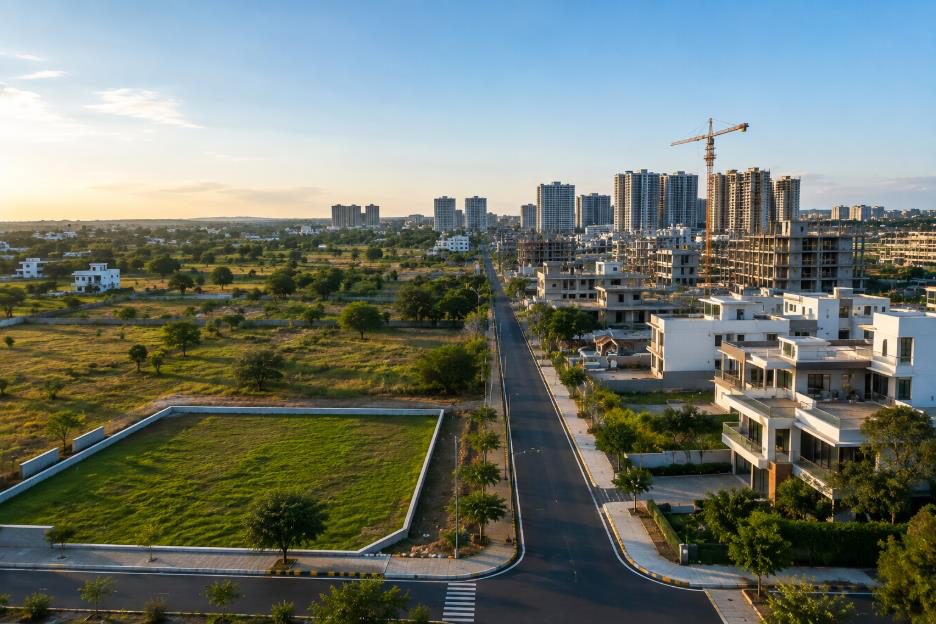
When you buy a plot in an emerging residential location, you are buying more than the land within its boundaries.
You are also buying into a neighbourhood that may look very different five or ten years from now.
At the time of purchase, the surroundings may still be relatively quiet. Some roads may carry little traffic. Nearby developments may be at an early stage. Schools, commercial spaces and other services may still be establishing themselves.
As development progresses, the context around your plot begins to change.
Understanding this process can help buyers evaluate land with a longer-term perspective.
1. A Plot Does Not Exist in Isolation
The characteristics of a plot matter: its size, dimensions, orientation, access and position within the development.
But the usefulness and desirability of that land are also influenced by what surrounds it.
Consider two identical plots in two different locations.
If one gradually gains stronger road connectivity, residential development, employment access and everyday services while the other remains relatively disconnected, the experience of owning those two plots can become very different over time.
This is why evaluating land requires looking beyond the project boundary.
2. Residential Development Creates a Different Kind of Neighbourhood
A plotted development can look sparse in its early years.
As owners begin constructing homes, that starts to change.
Vacant plots become residences. More people begin using the roads. Common spaces see activity. Landscaping matures. Services required by residents begin to find a market.
Eventually, what was purchased as a plot within a layout can become part of an established residential neighbourhood.
For long-term buyers, this transition is important to understand.
3. Roads Can Change How a Location Functions
Road infrastructure can significantly alter how people move through an area.
A location that once felt distant may become easier to access when new roads, junction improvements or regional connections become operational.
But buyers should distinguish carefully between infrastructure that is:
- Proposed
- Approved
- Under construction
- Operational
These are not the same thing.
When evaluating future infrastructure, verify the status through reliable or official sources rather than relying solely on projected timelines or marketing claims.
4. Schools and Institutions Can Change Everyday Usability
The arrival of schools, healthcare facilities and other institutions can make an emerging residential area more practical for everyday living.
For someone buying land today with the intention of building several years later, this matters.
A location does not need every convenience to exist on the day of purchase.
But buyers should examine whether the surrounding area is gradually developing the ecosystem required to support residential life.
The important question is not simply:
“What is nearby today?”
It is also:
“What evidence is there that this area is becoming more usable over time?”
5. Employment Growth Can Influence Residential Demand
Employment and residential demand are often connected.
When employment centres develop within a broader region, they can create demand for housing and supporting services in accessible surrounding locations.
However, proximity alone should not be treated as a guarantee of future demand or appreciation.
Buyers should consider how easily the location actually connects to employment areas, whether the announced developments are operational or progressing, and how the larger region is evolving.
The quality of the connection can matter as much as the distance.
6. Commercial Activity Often Follows Residential Activity
As more people begin living in an area, everyday requirements increase.
Retail, food and beverage, healthcare, services and other commercial activity may begin responding to that demand.
This process is rarely immediate or uniform.
But it illustrates why a neighbourhood should be evaluated as an ecosystem.
Residential development creates users.
Users create demand for services.
And those services can, in turn, make the location more practical for future residents.
7. Your Own Development Will Change Too
It is easy to focus exclusively on what is happening outside the project.
What happens inside matters just as much.
Roads and infrastructure progress.
Landscaping matures.
Amenities become operational.
Individual plot owners begin constructing.
Homes become occupied.
A project that may initially have been evaluated largely through a masterplan can gradually be evaluated through what physically exists.
For buyers, this is why the developer's execution and the quality of the original planning remain important even when the surrounding location is growing.
8. More Development Can Also Bring Trade-offs
Growth should not automatically be treated as entirely positive.
As an area develops, it may also experience:
- Increased traffic
- Greater construction activity
- Higher density
- Changing land use
- More noise and movement
- Pressure on existing infrastructure
This is why buyers should avoid evaluating future development simply by counting the number of projects announced nearby.
The type and quality of development matter too.
A location becoming busier is not necessarily the same as a location becoming better.
9. Watch for Evidence, Not Just Announcements
Emerging locations naturally attract ambitious projections.
A new road is announced.
A large institution is proposed.
A commercial development is discussed.
A future infrastructure project appears on a map.
These can all be relevant—but buyers should understand the difference between a proposal and something physically progressing on ground.
Look for evidence.
Visit the location periodically.
Observe road works.
Track official infrastructure updates.
See which developments have actually started.
Notice whether homes are being built and occupied.
A neighbourhood's evolution becomes much easier to understand when you follow what is happening on ground rather than only what is being announced.
10. Think in Years, Not Months
Land is generally evaluated differently from a short-term purchase.
The neighbourhood around a plot may take years to evolve.
That is why buyers considering land for a future home or long-term investment should think about the direction of the location rather than expecting every advantage to exist immediately.
Ask:
What is already here?
What is genuinely progressing?
What could reasonably improve accessibility and usability?
And what would still make this location relevant several years from now?
These questions create a more grounded basis for evaluating future potential.
The Plot Stays in the Same Place. Its Context Doesn't.
The physical boundaries of your plot may remain unchanged.
The world around those boundaries can change considerably.
Roads can improve. Homes can come up. Institutions can open. Commercial activity can increase. The development itself can mature.
There can also be new traffic, density and other trade-offs.
That is why buying land requires two evaluations:
The plot you are buying today—and the neighbourhood that may eventually grow around it.
Understanding both can help buyers make a more informed long-term decision.
About Bulwark Group
At Bulwark Group, we’re redefining real estate through transparency, planning, and infrastructure-aligned developments.
Bulwark Group is a premier luxury villa plots developer in Devanahalli, North Bangalore, specializing in eco-luxury and strategically located plotted developments. Committed to excellence and sustainable living, Bulwark offers visionary investors and homebuyers a unique opportunity to own high-value real estate with long-term growth potential near Bangalore’s airport.
Contact Bulwark Group
Location: First Floor, Door No. 3, Reshma Apartments, 196, near Airtel Office, opposite Kotak Bank, Jayamahal Extension, Bengaluru, Karnataka 560046
Email: enquiry@bulwarkgroup.in
Call: +91 963 282 6555
Interested in investing in North Bangalore?
Speak to one of our advisors and explore current plot availability in our premium communities.
Talk to an Advisor